Reflections on one-to-one gardening with Moyra
Moyra signed up for my year long, one-to-one gardening course in July 2025, and we had our first session together in Moyra’s garden in August. I write this article as we are just past the half-way point of our five sessions together – in February 2026. Below I have also included an article written by Moyra, which shares her own reflections on our sessions, entitled ‘Finding Permaculture’.
I hope, if you are thinking about doing one-to-one gardening sessions with me, that this might help to give you an idea of what to expect.
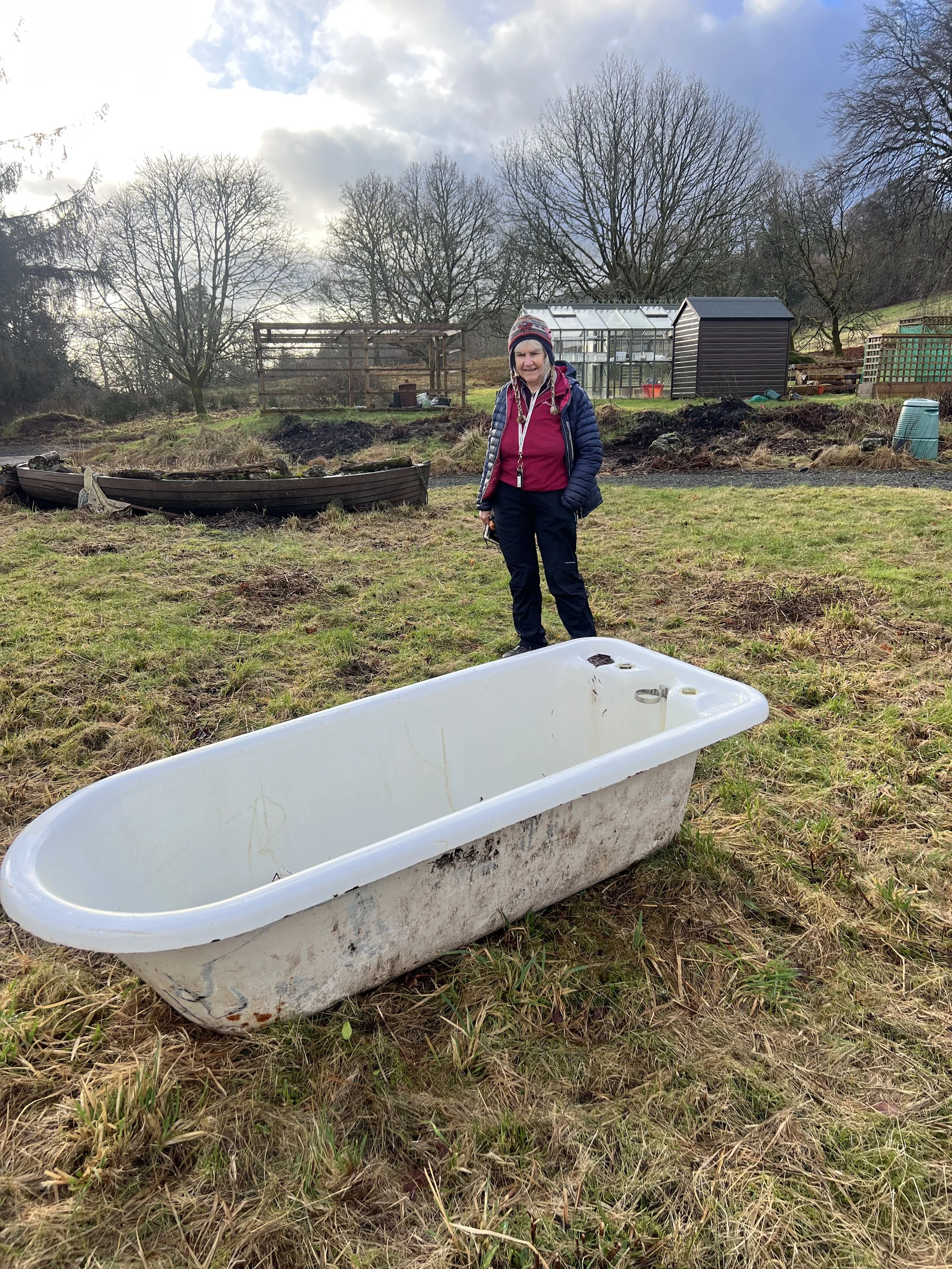
Moyra with an old bath, which she is set to transform into a Mediterranean-style planter
Background
When we first met, I was very interested to learn that Moyra was brought up on a market garden in Ayrshire - her parents grew fruit and vegetables for a living. Moyra therefore already had a solid foundation of growing and caring for plants, as well as a deep connection and understanding of the land, which to me was an incredible place to begin.
Moyra’s main objective for our five sessions together was to understand the principles of wildlife gardening, and how to integrate these into her garden planning and practice. We agreed that this would best be achieved through a combination of practical and hands-on gardening techniques, as well as theoretical and book-based learning. One of the first things I did was to create a reading list for Moyra – who is a keen reader and researcher - which she could draw upon throughout our time together. I’m delighted that she has been avidly working her way through it over the last six months.
While Moyra’s house and garden sits on around 6 acres of land, she wanted to keep the focus for our sessions on a few key areas of garden close to the house – a wildflower meadow, which she sowed in 2020, her kitchen garden and greenhouse, a new rockery, and a small woodland area, which she was eager to make more of and develop.
Session 1
Our first session together was spent exploring Moyra’s garden, with a view to getting to grips with each of the areas she was eager to work on and develop. I created a resource for Moyra about soil – explaining what it is and how it is created, then we went out into the garden where I encouraged Moyra to hold the soil in her hands, in order to understand its texture and temperament. She explained to me how the soil felt – sticky, small particles, cool. We took pH readings across the garden and we were fascinated to see how varied they were – it is so worthwhile testing across the garden for this reason. We also took stock of Moyra’s existing plants in each of the different areas, so that she had an inventory of plants to refer to as she moves on with her garden development.
In order to address Moyra’s wildlife gardening interest, I created Moyra a comprehensive resource about how to garden for wildlife, which included key pointers such as having something in flower during every month of the year, having untidy corners and leaving plenty of habitat for wildlife over winter. We also looked at how Moyra could begin to create a rockery, using large stones she already had on site, to house new rockery plants that she was growing from seed in her greenhouse.
Session 2
Moyra had expressed an interest during our first session to learn about permaculture – she had bought a book about creating a forest garden and was keen to discover more. Back in 2021, I completed a Permaculture Design course, and so I was delighted to get the opportunity to jog my memory in order to share some of that course content with her.
We spent the first half of our session going over the 12 permaculture principles, and I encouraged Moyra to give me real life examples of how they apply in the setting of her garden, as well as with her as the gardener. What we quickly realised was that Moyra was already living and breathing so many of the principles – she was in fact gardening very ‘permaculturally’, without perhaps realising it. Some of the principles that really stood out to me that she was practicing already included ‘Produce no waste’ – she was composting and using sustainable resources already on site for new projects, ‘Observe and interact’ – she was already noticing how wildlife was using the garden and was creating space for this, ‘Use and value diversity’ – Moyra already had a thriving wildflower meadow with lots of interest from early spring all the way through until the autumn.
We spent the remaining part of this session talking about how Moyra should manage her wildflower meadow through each of the seasons – eg cutting back and collecting it in the autumn, planting plug plants in the spring, etc. We also planted some spring bulbs and Moyra got to grips with how to prune the climbing roses near her house – a task that she was a little bit unsure of, as she didn’t want to damage the roses that had a lot of sentimental value to her and her husband.
Session 3
During this session we continued to expand Moyra’s knowledge about permaculture, and I introduced her to permaculture ‘Zoning’. This basically involves physically zoning your garden from numbers 1-5, with zone 1 being areas you visit every day and zone 5 being areas that are completely wild and you don’t visit. Zoning encourages the garden owner to manage their own energy effectively, and consider where to site different garden elements to maximise garden flow, and space for wildlife to thrive.
As it was January, Moyra was keen to start the year by creating a maintaining a garden journal, with a focus on her new found interest in permaculture. We spent time going over how to make this endeavour successful, and how Moyra could organised her diary cohesively, and ensure she kept it up on a weekly basis.
We also drew out a ‘base map’ of Moyra’s garden, with each of the different areas included. Together we allocated zones to each of the areas, and Moyra also used this drawing to note down weather patterns, such as sun and shade and prevailing winds. The pH levels for each different section were also recorded on this map. Moyra was going to attach this to the front of her garden journal, and will use this as a reference map moving forward.
Future sessions
Moyra and I have two sessions remaining together, and I hope she is looking forward to them as much as I am. We will continue to focus on wildlife gardening and expanding Moyra’s permaculture knowledge. One area that Moyra would like to focus more energy on is the woodland area in her garden – we will be looking at how she could start to ‘forest garden’ this area over 2026. Permaculture talks about ‘small and slow solutions’ and Moyra is keen to start to create a forest garden in this section in that exact way.
We will be looking at how she can use ‘no-dig’ methods in order to develop the space, maximising yields in terms of perennial fruits and vegetables, whilst having a minimum footprint, so that her garden can continue to be a haven for wildlife and pollinators.
The time that Moyra and I have spent together so far has been fun, light hearted and very educational – hopefully for both parties. I am really looking forward to our remaining sessions together.
Finding Permaculture, words from Moyra
“I have a life-long love of gardening. A bit of a ‘wild child’, inclined to get into trouble unless occupied, from a young age I accompanied my dad when he was working as a jobbing gardener and in the family market garden. I learned to prune roses around aged eight and had a tiny garden patch crammed with left-over bulbs. I did not pursue horticulture as a career but over the years, shared an allotment with a friend then had a beautiful Victorian sunken garden which I developed as a type of potager. Problems arose however when we moved to our current house. Lovely old, converted farm buildings, lawns with a few rhododendrons merge into woodland; a dense bank of scrub runs down to a small loch, deer sleep on the doorstep in adverse weather and a pine martin chased me into the house one snowy night. A beautiful location but what to do with the garden? I developed a thriving kitchen plot, raised beds, fruit cage and greenhouse, growing tomatoes, sweetcorn and peppers but what about the rest of the area, some six acres? I sowed a small area of wildflowers on what had been an old tennis court; knapweed, red and white clover, ox eye daisies, lupins and Meadow Vetchling blossomed but an abundance of Broad Leaf Dock and nettles seemed to be taking over. Literature cautioned against getting rid of these as various beasties thrived on them. How to prevent this beautiful area becoming a wilderness? Then I came across Nicola.
“Happy to do the work myself, I needed guidance. I enrolled for one-to-one tuition for the year. That way I have support to plan and respond each season. In her first visit, Nicola suggested that my approach was akin to ‘permaculture’. Permaculture was a word I recognised but did not fully understand. Nicola suggested some reading and everything fell into place. I felt I had ‘come home’.
“Permaculture has been described by the Permaculture Association as ‘a philosophy of working with, rather than against nature. It encourages a connected approach… Permaculture ethics and design principles can be applied to every area of your life. Permaculture offers ways we can sustain human activities for many generations to come, in harmony with nature’. At the heart of permaculture are 12 design principles and since starting my journal, I focus on one each week. The first was ‘Observe and interact: take time to watch and learn before acting, beautifully described by Aranya as ‘Don’t just do something, stand there….’[i] I am currently monitoring successes and failures. Primroses raised from seed and Hellebores have survived the rigours of our weather and the local deer. I need to research other deer-resistant plants. Next, ‘Use small and slow solutions: work with manageable steps, rather than taking on too much at once’. I may never have a ‘show garden’ but I hope for one where wildlife and family can live in harmony.”
[i] Aranya, Permaculture Design: A step-by-step-guide. (Portsmouth, Permanent Publications, 2012)